
The Unseen Vulnerability: Why Environment Variable Security Matters
In the intricate tapestry of modern software applications, environment variables serve as crucial conduits, delivering configuration settings, API keys, database credentials, and other sensitive data to your code at runtime. They are the silent enablers, allowing applications to adapt to different deployment environments—from local development machines to staging servers and production clusters—without requiring code changes. Yet, their very utility makes them a prime target for attackers and a significant vector for data breaches if not handled with the utmost care.
For developers, IT professionals, and app builders, understanding and implementing robust environment variable security is not merely a best practice; it is a fundamental pillar of application security. An exposed database password or API key, even momentarily, can lead to devastating consequences, including unauthorized data access, system compromise, and significant reputational damage. As applications become more distributed and complex, the attack surface expands, making diligent security practices for these often-overlooked components more critical than ever.
Consider the potential impact:
- Data Breaches: Exposed database credentials can grant full access to your application’s data.
- Service Interruptions: Compromised API keys can be used to disrupt third-party services your application relies on.
- Unauthorized Access: Leaked secret keys (e.g., session secrets) can allow attackers to impersonate users or gain administrative control.
The imperative for strong environment variable security cannot be overstated. It is a proactive measure that shields your application from common vulnerabilities and ensures the integrity and confidentiality of your operations.
Understanding Common Threats to Environment Variables
Before we delve into solutions, it’s vital to grasp the avenues through which environment variables can be compromised. Recognizing these threats is the first step toward building a resilient security posture for your application’s configuration.
Accidental Exposure in Version Control
Perhaps the most common and easily avoidable security blunder is committing sensitive environment files (like .env files) directly into public or private version control repositories (e.g., Git, SVN). While private repositories offer a layer of obscurity, they are not foolproof, especially in large teams or if access controls are misconfigured. Public repositories, however, are an open invitation for attackers.
Once committed, even if quickly removed, the sensitive data can often persist in the repository’s history, making it discoverable through Git history analysis tools. This type of exposure often stems from oversight or a misunderstanding of how environment variables should be managed within development workflows.
“Leaking secrets into version control systems, even temporarily, creates a persistent vulnerability that can be exploited long after the sensitive data is seemingly removed.”
— OWASP (Open Web Application Security Project)
Runtime Introspection and Process Spying
Once an application is running, its environment variables are accessible to the process itself. However, other processes or users with sufficient privileges on the same system might be able to read these variables. Tools like ps auxeww on Linux or various debugging utilities can expose the command line and environment of running processes. If an attacker gains even limited access to your server, these tools can become potent instruments for extracting secrets.
This threat highlights the importance of adhering to the Principle of Least Privilege for user accounts and services running your applications.
Build-Time Leaks in CI/CD Pipelines
Automated CI/CD (Continuous Integration/Continuous Delivery) pipelines are indispensable for modern development. However, misconfigured pipelines can inadvertently expose environment variables during the build or deployment process. Logs generated by CI/CD tools often contain verbose output, and if sensitive variables are printed to standard output or error streams, they can be permanently recorded in the build history, accessible to anyone with log viewing permissions.
Ensuring that CI/CD systems mask sensitive output and provide secure mechanisms for injecting secrets is paramount for effective environment variable security.
Injection Attacks and Malicious Inputs
While less direct, malicious inputs can sometimes lead to an application processing unintended environment variables or exposing existing ones. For instance, if an application constructs shell commands using unsanitized user input, an attacker might be able to inject commands that reveal environment variables or manipulate their values. This underscores the broader importance of input validation and secure coding practices alongside dedicated environment variable handling.
Fundamental Principles for Robust Environment Variable Security
Securing environment variables effectively requires adherence to several core principles that guide both development practices and infrastructure configuration. These principles form the bedrock of a strong environment variable security posture.
The Principle of Least Privilege
This fundamental security tenet dictates that any user, program, or process should be granted only the minimum necessary permissions to perform its intended function. Applied to environment variables, this means:
- Limiting which users can view or modify environment variables on a server.
- Ensuring that application processes run with credentials that can only access the environment variables directly relevant to them, and nothing more.
- Restricting access to secrets management systems.
Isolation and Segregation
Sensitive environment variables should be isolated from less sensitive configurations. This involves:
- Using dedicated secrets management solutions rather than simple
.envfiles for production. - Separating configurations per environment (development, staging, production) to prevent accidental leakage from one to another.
- Employing mechanisms like Docker containers or Kubernetes Pods to provide runtime isolation for application processes and their respective environments.
Never Commit Sensitive Data
This rule is non-negotiable. No sensitive API keys, database passwords, or private keys should ever be committed to version control, regardless of whether the repository is public or private. Tools like .gitignore are your first line of defense, but developers must be diligent in ensuring they are correctly configured and adhered to.
For guidance on preventing accidental commits, explore how to hide environment variables from Git.
Encryption at Rest and In Transit
Sensitive environment variables should be encrypted wherever they are stored (at rest) and whenever they are transmitted (in transit). This adds a crucial layer of protection, rendering the data unintelligible to unauthorized parties even if they gain access to the storage location or intercept network traffic.
- At Rest: Storing secrets in encrypted files or dedicated secrets management services that encrypt data on disk.
- In Transit: Using TLS/SSL for any communication channel that transfers environment variables (e.g., between a secrets manager and your application).
Auditing and Monitoring Access
Maintaining logs of who accessed which environment variables, when, and from where is critical for detecting and responding to potential breaches. Modern secrets management systems typically offer robust auditing capabilities, providing a historical record that can be invaluable for forensic analysis and compliance.
Implementing Secure Practices: A Developer’s Arsenal
Translating these principles into actionable steps requires a combination of disciplined practices and the strategic use of specialized tools. Here’s how developers can bolster their environment variable security.
Strategic Use of .gitignore and Beyond
The .gitignore file is your initial defense against committing sensitive environment variables to version control. Always include entries for files like .env or any custom configuration files that hold secrets. However, .gitignore is merely a prevention tool; it doesn’t solve the problem of how to distribute these secrets securely to your team or production servers. It’s a foundational step, but not the complete solution for robust environment variable security.
Leveraging Secrets Management Systems
For production environments, relying solely on local .env files is insufficient. Dedicated secrets management systems are designed to securely store, retrieve, and manage sensitive information. Popular options include:
- HashiCorp Vault: A comprehensive solution for managing secrets and protecting sensitive data.
- AWS Secrets Manager / Parameter Store: Cloud-native services that integrate seamlessly with AWS ecosystems.
- Azure Key Vault: Microsoft Azure’s cloud service for securely storing and accessing secrets.
- GCP Secret Manager: Google Cloud’s fully managed service for storing API keys, passwords, certificates, and other sensitive data.
These systems provide features like encryption, access control, auditing, and dynamic secret generation, significantly enhancing environment variable security.
Runtime Injection: Minimizing Exposure
Instead of baking secrets into application images or static configuration files, the most secure approach is to inject environment variables at runtime. This means the sensitive data is only available to the application process for the duration it needs it, reducing the window of exposure.
“Secrets should be injected into applications at runtime, rather than being stored statically in files or configuration bundles, to minimize their exposure and enable dynamic rotation.”
— NIST (National Institute of Standards and Technology) Cybersecurity Framework
Containerization platforms like Docker and Kubernetes excel at this, allowing you to pass environment variables securely or mount secrets directly into containers as files, often without them ever touching the host’s filesystem directly. CI/CD pipelines can also be configured to fetch secrets from a secrets manager and pass them to the deployment target just before application startup.
Generating Strong, Unique Secrets
The strength of your secrets directly impacts your environment variable security. Avoid weak, predictable, or reused passwords/keys. Instead, generate long, complex, and cryptographically random values for sensitive items like session secrets, API keys, and HMAC keys. Tools exist to help you create these robust identifiers.
- Need a strong session secret? Use a session secret generator.
- For HMAC keys, a reliable ALTCHA HMAC key generator can provide the randomness you need.
The uniqueness of each secret, especially per environment and per application instance, adds another layer of security, limiting the blast radius if one secret is compromised.
Encrypting Environment Variables
While secrets managers provide encryption, you might encounter scenarios where you need to encrypt specific environment files or variables directly, perhaps for local storage or limited distribution. Tools that encrypt .env files can be invaluable here, ensuring that even if a file is accessed without authorization, its contents remain unreadable.
Consider using a tool like Envtools’ environment variable encryptor to add an extra layer of protection to your configuration files, especially when sharing encrypted versions across a development team.
Addressing Misconceptions in Environment Variable Security
Several common misunderstandings can lead to significant security gaps. Clarifying these is crucial for fostering a robust security culture.
“Obscurity is Security”
This is a dangerous fallacy. Hiding secrets in obscure locations, renaming files, or simply keeping them out of public view does not constitute security. A determined attacker will eventually find them. True security comes from robust encryption, access controls, and a multi-layered defense strategy, not just hoping no one looks in the right place.
“Local Development Is Inherently Safe”
While local machines might seem less exposed than production servers, they are still vulnerable. Malware, phishing attacks, or even stolen laptops can expose sensitive environment variables stored unencrypted. Developers should adopt secure practices even for local environments, using encrypted local storage or ephemeral secrets where possible.
“It’s Just Configuration, Not a Secret”
The line between configuration and secret can blur. If a configuration value, like an API endpoint, is tied to a specific account or grants access to certain resources, it should be treated with the same rigor as a password. Any piece of information that, if exposed, could lead to unauthorized access or system compromise is a secret and demands appropriate environment variable security measures.
The Role of CI/CD in Environment Variable Security
CI/CD pipelines are central to modern development and pose unique challenges and opportunities for environment variable security. Securing your pipeline is as important as securing your application itself.
Securely Passing Variables
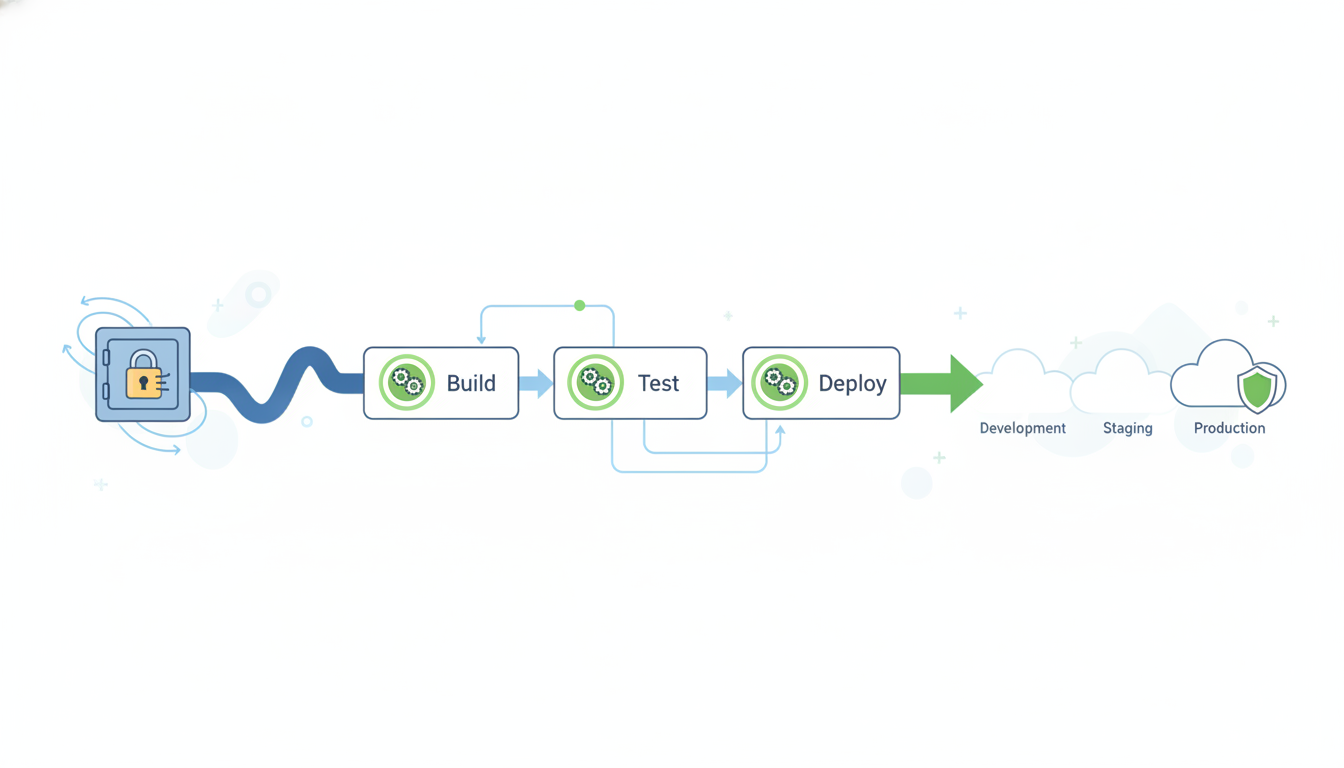
Most modern CI/CD platforms (e.g., GitHub Actions, GitLab CI/CD, Jenkins) offer dedicated features for handling secrets. These mechanisms are designed to retrieve secrets from secure vaults (often integrated with cloud providers or HashiCorp Vault) and inject them as environment variables into build or deployment jobs without exposing them in scripts or logs. Always prioritize using these native secret management features over hardcoding or passing secrets through insecure channels.
Masking Sensitive Output
Even with secure injection, accidental logging of sensitive variables can occur. CI/CD systems provide options to mask sensitive strings in logs. Configure your pipelines to identify and mask any output that might contain secrets, preventing them from being recorded permanently in accessible build logs.
Emerging Trends in Secure Configuration Management (as of 2026)
The landscape of application security is constantly evolving. As of 2026, several trends are further shaping how we approach environment variable security:
- “Shift Left” Security: Integrating security practices earlier into the development lifecycle, ensuring developers are trained and equipped to handle secrets securely from the start.
- Zero Trust Architectures: Increasingly, organizations are adopting zero-trust principles, where no user or system is implicitly trusted, even inside the network perimeter. This mandates strict authentication and authorization for accessing any resource, including environment variables.
- Ephemeral Secrets: The use of short-lived, dynamically generated secrets that are rotated frequently and invalidated after use, further reducing the window of opportunity for attackers.
- Code Scanning for Secrets: Automated tools are becoming more sophisticated at detecting hardcoded secrets or accidental exposures in source code, even before it hits version control.
“Adopting a zero-trust model for configuration and secrets access, combined with automation and dynamic credentials, is becoming the industry standard for preventing widespread compromise.”
— Major Cloud Security Best Practices Guides (e.g., AWS, Microsoft Azure, Google Cloud)
These trends emphasize a proactive, automated, and least-privilege approach to managing all sensitive configuration data.
Conclusion
Environment variable security is a critical, ongoing challenge for every developer and organization building and deploying software. While the convenience of environment variables is undeniable, their inherent sensitivity demands a rigorous approach to their management. By understanding common threats, adhering to fundamental security principles like least privilege and isolation, and leveraging appropriate tools and technologies—from robust secrets management systems to secure CI/CD practices—you can significantly mitigate risks.
Prioritizing environment variable security protects not only your applications and data but also maintains the trust of your users and stakeholders. Make it a foundational element of your development workflow, and continuously educate your teams on these vital practices to safeguard against an ever-evolving threat landscape.
Strengthen Your Environment Variable Security Today
Ready to enhance your application’s security posture? Explore Envtools for powerful utilities designed to help you manage and secure your environment variables:
- Generate strong, cryptographically secure secrets with our Session Secret Generator.
- Encrypt your environment variables for safe distribution using our Env Encryptor.
- Ensure your sensitive files never reach version control with our guide on hiding environment variables from Git.
Visit Envtools.dev to discover more tools and resources for secure and efficient environment management.
FAQ: Environment Variable Security for Beginners
- What is an environment variable?
- An environment variable is a dynamic named value that can affect the way running processes behave on a computer, often used by applications to store configuration settings or secrets like API keys.
- Why are environment variables considered a security risk?
- They become a security risk because they often contain sensitive data (passwords, keys) that, if exposed, can grant unauthorized access to databases, services, or application functionalities.
- What is the easiest way to prevent exposing environment variables?
- The simplest first step is to never commit files like
.envto version control systems like Git, achieved by adding them to your.gitignorefile. - Should I encrypt environment variables?
- Yes, especially for production environments or when they contain highly sensitive data; encryption at rest and in transit adds a critical layer of protection against unauthorized access.
- What are secrets management systems?
- Secrets management systems are specialized platforms (e.g., HashiCorp Vault, AWS Secrets Manager) designed to securely store, distribute, and manage sensitive application data like API keys and database credentials with robust access controls and auditing.