
Environment Variable Lifecycle Management is the comprehensive process of overseeing environment variables from their initial creation and definition through their secure storage, distribution, usage, updates, and eventual deprecation across all stages of software development and deployment. It ensures application configurations are consistently applied, secure, and auditable across different environments.
For IT professionals, developers, and app builders, mastering this lifecycle is not merely a best practice; it is a fundamental requirement for building secure, scalable, and maintainable systems. Mishandling environment variables can lead to critical security vulnerabilities, deployment errors, and significant operational overhead. This guide delves into the core components of effective environment variable management, offering insights into optimizing your configuration workflows.
What is Environment Variable Lifecycle Management?
At its heart, environment variable lifecycle management is about bringing structure and control to how your applications receive and interpret their external configuration. Instead of ad-hoc settings scattered across various files or hardcoded values, this approach advocates for a systematic methodology. It acknowledges that environment variables, like other code artifacts, have a defined lifespan and require careful handling at each stage.
This systematic approach encompasses everything from deciding what constitutes an environment variable for a given service to how it’s injected into a running container, updated without downtime, and eventually retired. Effective lifecycle management aims to minimize human error, reduce security risks associated with sensitive data exposure, and streamline deployment processes, making applications more resilient and easier to manage at scale. It’s a continuous process that evolves with your application and infrastructure.
The Stages of the Environment Variable Lifecycle
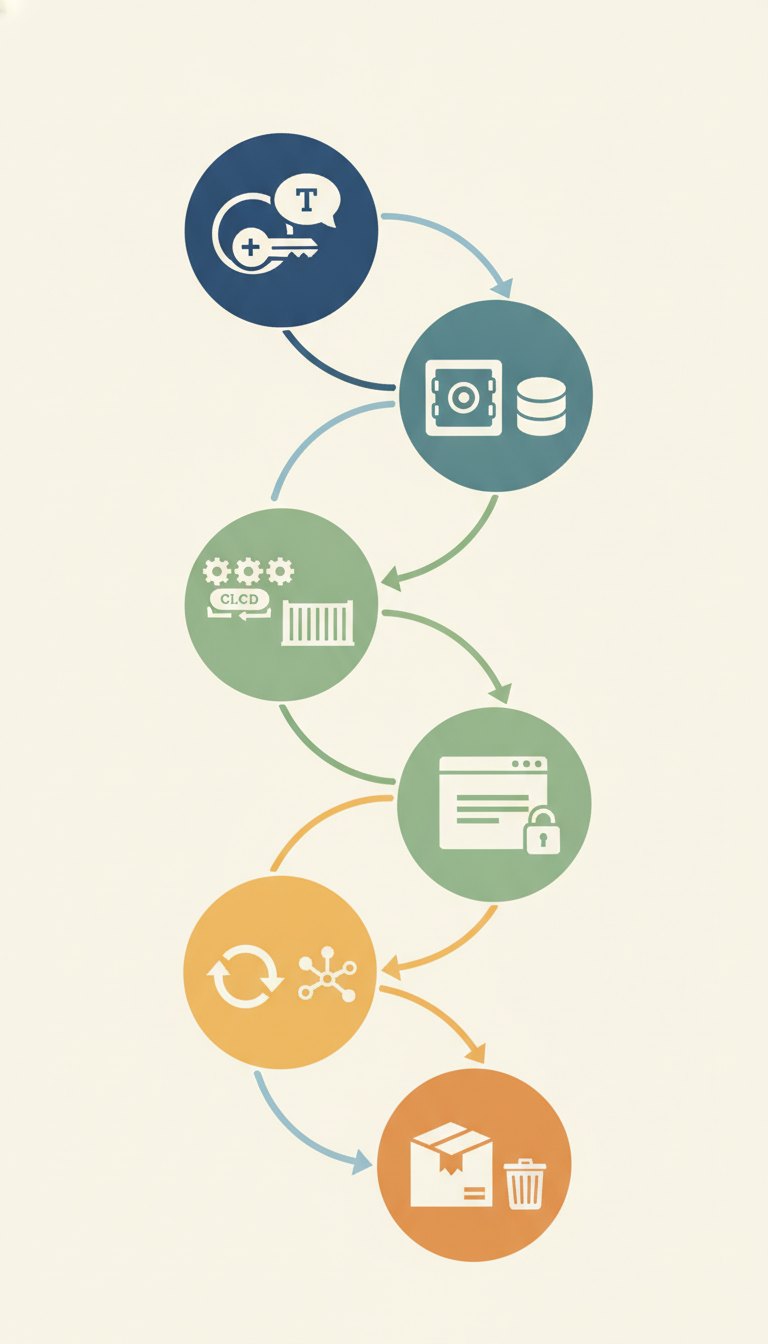
The journey of an environment variable can be broken down into several distinct stages, each presenting unique challenges and requiring specific considerations. Understanding these stages is critical for implementing robust management practices.
1. Creation and Definition
This initial stage involves identifying which configuration parameters should be externalized as environment variables. Key considerations include sensitivity (e.g., API keys, database credentials), variability across environments (e.g., development vs. production database URLs), and application behavior switches (e.g., debug modes). Establishing clear naming conventions (e.g., APP_DATABASE_HOST, STRIPE_SECRET_KEY) is paramount for readability and preventing conflicts, especially in larger projects or microservice architectures. Tools like generators for specific keys, such as an Rails secret key generator, exemplify this initial creation phase.
2. Storage and Retrieval
Once defined, environment variables must be stored securely and retrieved reliably by applications. For non-sensitive configurations, .env files or configuration management systems might suffice. However, sensitive data, like API keys or cryptographic secrets, requires dedicated secret management solutions (e.g., HashiCorp Vault, AWS Secrets Manager, Azure Key Vault). The choice of storage dictates access control mechanisms, encryption at rest, and audit trails. Best practices dictate that secrets should never be committed directly to version control. For more on this, consider resources on where to store API keys.
3. Distribution and Injection
This stage involves getting the correct environment variables into the appropriate application instance in the right environment (development, staging, production). This is often handled by CI/CD pipelines, container orchestrators (Kubernetes, Docker Swarm), or platform-as-a-service (PaaS) providers. The goal is to inject variables just-in-time and without exposing them unnecessarily. Techniques include mounting secret volumes, passing variables directly at container runtime, or using build-time variable substitution. An environment splitter can be invaluable here, ensuring only necessary variables are distributed to specific contexts.
4. Usage and Access Control
Once injected, applications access environment variables at runtime. Developers must ensure applications read these variables correctly and that no sensitive data is logged unnecessarily or exposed through error messages. Access control extends beyond storage; it also concerns which services or users can request which variables. Principle of least privilege should be strictly applied, ensuring applications only have access to the variables they absolutely need to function. Robust access management is a cornerstone of secure operations.
5. Updates and Versioning
Environment variables are not static; they change due to security rotations, infrastructure migrations, or feature updates. Managing these changes requires a clear process. This includes versioning of configurations, ensuring rollbacks are possible, and having a deployment strategy that minimizes downtime during updates. Dynamic configuration systems can push updates without requiring application restarts, while others might necessitate a graceful redeployment. The ability to validate environment variables after updates is crucial to prevent runtime errors.
6. Archiving and Deprecation
Eventually, environment variables become obsolete. This could be due to a service being retired, a feature removed, or a security key rotation. Deprecation involves clearly marking variables as no longer in use, removing them from active configurations, and archiving historical values if legally or compliantly required. This prevents clutter, reduces the attack surface, and simplifies ongoing management. A clean deprecation process contributes significantly to long-term system hygiene.
Core Principles for Effective Lifecycle Management
Adhering to foundational principles is key to building a resilient environment variable management strategy that stands the test of time and scale.
Security by Design
Security must be ingrained at every stage. This means encrypting sensitive variables at rest and in transit, implementing strict access controls (least privilege), rotating credentials regularly, and ensuring audit trails are in place to track who accessed what, when, and from where. Hardcoding secrets or exposing them in public repositories is a critical vulnerability. Leveraging tools specifically designed for API key generation and secure storage significantly enhances this principle.
Organizations should prioritize least privilege access, strong encryption, and regular auditing for all sensitive configuration data, including environment variables, to mitigate the risk of data breaches.
— National Institute of Standards and Technology (NIST)
Consistency Across Environments
Applications should behave predictably regardless of the environment (development, staging, production). This requires ensuring that configuration variations are well-defined and consistently applied. Automated tools and standardized templates help prevent configuration drift. Differences should be explicit and intentional, not accidental. A robust validation process, possibly through a tool like env-validator, can enforce this consistency, catching discrepancies before they cause issues.
Auditability and Traceability
In regulated industries or complex systems, knowing the origin, changes, and access history of an environment variable is crucial. Implementing robust logging and version control for configuration changes allows teams to trace back issues, comply with regulations, and understand the impact of configuration modifications. This transparency is vital for debugging and maintaining system integrity over time.
Automation and Integration
Manual management of environment variables is error-prone and scales poorly. Automating their creation, distribution, updates, and even deprecation through CI/CD pipelines, infrastructure-as-code (IaC), and dedicated tools significantly reduces operational burden and improves reliability. Integration with existing development and deployment workflows ensures that environment variable changes are part of a controlled, repeatable process.
The Twelve-Factor App methodology mandates strict separation of config from code, emphasizing environment variables as the ideal mechanism for injecting configuration that varies between deploys.
— The Twelve-Factor App
Common Pitfalls and How to Avoid Them
Even with good intentions, several common mistakes can undermine effective environment variable lifecycle management. Recognizing these pitfalls is the first step toward avoiding them.
- Hardcoding Secrets: Embedding API keys, database credentials, or other sensitive information directly into application code. This is a critical security vulnerability, making secrets accessible in version control and deployment artifacts.
- Over-Reliance on
.envFiles in Production: While useful for local development,.envfiles are often not suitable for production due to their lack of access control, auditing capabilities, and dynamic update mechanisms. - Inconsistent Naming Conventions: Using different names for the same logical variable across services or environments leads to confusion, errors, and difficulty in automation.
- Lack of Version Control for Configurations: Not treating configuration files (or the definitions that generate environment variables) as code means losing the ability to track changes, rollback, or review modifications.
- Manual Variable Updates: Updating environment variables manually across multiple servers or environments is time-consuming, prone to human error, and lacks an audit trail.
- Neglecting Deprecation: Leaving old, unused environment variables in active configurations clutters the environment, increases cognitive load, and can sometimes introduce unexpected behavior or security risks.
To avoid these, embrace automation, leverage dedicated tools, establish clear policies, and conduct regular audits. Proactive error detection, such as understanding how to fix environment errors, can also prevent many common issues from escalating.
Tools and Strategies for Streamlined Lifecycle Management
Implementing effective environment variable lifecycle management doesn’t have to be a Herculean task. A variety of tools and strategies can automate and secure the process.
Configuration Management Systems
Tools like Ansible, Chef, or Puppet can define, manage, and deploy configurations across an entire infrastructure. They ensure consistency by applying predefined states to servers and services, including setting environment variables. These are particularly useful in traditional server-based deployments.
Secret Management Tools
For sensitive environment variables, dedicated secret management solutions are indispensable. HashiCorp Vault, AWS Secrets Manager, Azure Key Vault, and Google Secret Manager provide secure storage, dynamic secret generation, granular access control, and auditing capabilities. They integrate with CI/CD pipelines and orchestrators to inject secrets securely at runtime.
CI/CD Pipelines and Container Orchestrators
Modern CI/CD platforms (e.g., GitLab CI, Jenkins, GitHub Actions) and container orchestration systems (Kubernetes, Docker Swarm) are central to the distribution and injection stages. They allow environment variables to be defined, encrypted, and passed to application containers securely and automatically during deployment, minimizing manual intervention.
Leveraging native secret management capabilities within container orchestration platforms like Kubernetes is a critical security control, enabling secure injection of sensitive environment variables directly into application pods.
— Kubernetes Documentation
Dedicated Environment Variable Tools
Platforms focusing specifically on environment variable management can offer specialized features like variable validation, comparisons between environments, and automated cleaning. These tools can fill gaps left by broader configuration or secret management systems, providing granular control and improved visibility over your application’s external configurations. For a suite of tools that aid in various aspects of environment variable handling, explore what Envtools offers.
Conclusion
Effective environment variable lifecycle management is a non-negotiable aspect of modern application development. By systematically approaching the creation, storage, distribution, usage, updates, and deprecation of environment variables, development teams can significantly enhance security, improve operational efficiency, and ensure application consistency across diverse environments. Adopting the principles of security by design, consistency, auditability, and automation, coupled with the right suite of tools, will pave the way for more robust, maintainable, and scalable applications. Invest in your configuration practices today to build more resilient systems for tomorrow.
Frequently Asked Questions (FAQ)
Q1: What is the difference between environment variables and configuration files?
Environment variables are OS-level key-value pairs external to the application code, ideal for settings that change per deployment, while configuration files are typically part of the application’s codebase or deployment artifact, often used for more static, application-specific settings.
Q2: Why should I not commit .env files to Git?
Committing .env files to Git, especially those containing sensitive data, exposes your secrets to anyone with repository access, creating a significant security vulnerability and making credential rotation more complex.
Q3: How often should I rotate sensitive environment variables like API keys?
The frequency depends on security policies and compliance requirements, but best practice suggests rotating sensitive keys regularly, typically every 30-90 days, or immediately if a compromise is suspected.
Q4: Can environment variables be used for all types of configuration?
While versatile, environment variables are best for simple key-value pairs that vary by environment; for complex, structured configurations or very static data, dedicated configuration files (e.g., YAML, JSON) might be more appropriate.
Q5: What are the risks of poor environment variable management?
Poor management can lead to security breaches due to exposed secrets, application downtime from misconfigurations, inconsistent behavior across environments, difficulty in debugging, and compliance failures.
Explore More Guides and Tools
Dive deeper into specific aspects of environment variable handling and application configuration. Visit our Guides section for more in-depth articles or explore our comprehensive suite of environment tools designed to streamline your development workflow and enhance security.