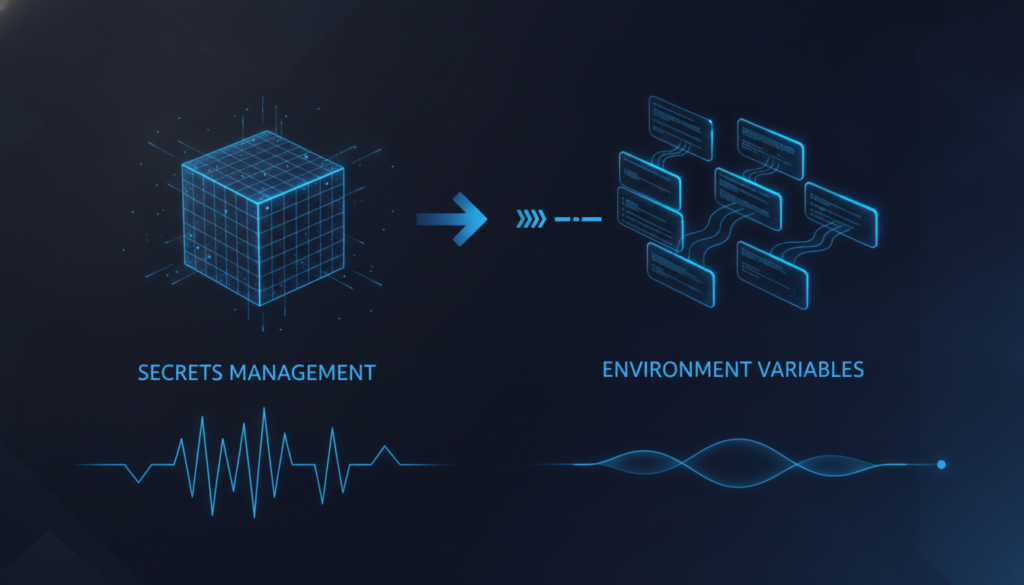
Environment variables are dynamic key-value pairs maintained by an operating system or container runtime to pass configuration settings to applications, whereas secrets management refers to specialized software platforms designed to encrypt, audit, store, and dynamically rotate sensitive credentials like private keys and API tokens. While environment variables provide a simple delivery mechanism for application parameters, dedicated secrets management tools safeguard high-value payloads from memory inspection, unauthorized leak vectors, and unencrypted persistence.
As modern application architecture shifts toward cloud-native microservices, serverless deployments, and automated CI/CD pipelines, engineering teams often face a critical design question: how should application runtime parameters be isolated from highly confidential keys? Understanding the core technical capabilities, attack surfaces, and trade-offs in the debate over secrets management vs environment variables is essential for building resilient, secure systems in 2026.
Defining the Core Distinction: Configuration Data vs. Sensitive Credentials
At their core, environment variables and secrets management systems address two related but distinct software requirements: operational configuration and access control. Configuration data dictates how an application behaves across different deployment stages, such as turning on debug logs, configuring feature flags, or defining local service hostnames. In contrast, secret data consists of sensitive items—database passwords, cryptographic keys, OAuth tokens, and API credentials—that grant access to privileged resources.
Environment variables act as a simple runtime configuration channel. They decoupling app settings from source code by exposing values directly inside the operating system process block. However, an environment variable itself provides no encryption, access auditing, key rotation, or fine-grained access permissions. It is simply a string stored in unencrypted process memory.
Secrets management solutions, by contrast, are specialized identity-aware key-value vaults built around security primitives. They enforce zero-trust access control, encrypt data both in transit and at rest using strong cryptographic algorithms (such as AES-256), track every access event in immutable audit logs, and automatically rotate credentials without requiring process restarts or redeployments.
The Anatomy of Environment Variables: How Operating Systems Pass Application State
To evaluate how environment variables operate within application boundaries, it helps to understand their lifecycle inside modern operating systems and container runtimes. When a process starts in Unix-like or Windows systems, the OS kernel allocates a dedicated block of process memory containing environment variables as an array of null-terminated key-value strings.
During child process initialization, the operating system copies the parent process’s environment environment block into the child’s address space. This inheritance mechanism makes environment variables an ideal delivery layer for microservices running inside Docker containers or Kubernetes pods. Developers can pass runtime values seamlessly without modifying compiled binaries or building environment-specific container images.
In local development workflows, tools like dotenv read local plain-text configuration files and populate process environment blocks before execution. For developers looking into understanding what an .env file is, these local files provide a straightforward way to load development variables without exposing system-level changes across the whole OS.
The Twelve-Factor App methodology mandates strict separation of config from code, requiring configuration that varies between deploys to be stored in environment variables rather than hardcoded in application repositories.
— 12-Factor App Methodology
What Defines Dedicated Secrets Management Systems?
Secrets management systems exist to solve the fundamental vulnerabilities inherent in storing high-value authentication credentials as static, unencrypted plain text. Unlike simple key-value stores or process environment blocks, dedicated secrets managers function as centralized security controllers that enforce authorization policies before handing over sensitive credentials.
Modern secret management platforms—such as HashiCorp Vault, AWS Secrets Manager, Azure Key Vault, and GCP Secret Manager—rely on hardware-backed master keys,Envelope Encryption, and automated access control policies. Key capabilities include:
- Dynamic Secret Generation: Creating short-lived, single-use database credentials on demand rather than relying on static, permanent passwords.
- Automatic Rotation: Updating keys on a defined schedule or after security events without manual human intervention.
- Centralized Audit Logging: Recording exact timestamps, identity tokens, IP addresses, and requested secret paths for every single read or write access attempt.
- Fine-Grained Access Control: Applying precise identity and access management (IAM) policies that limit secret visibility down to individual microservice service accounts.
By shifting secret lifecycle management out of application configurations and into a dedicated cryptographic vault, organizations reduce the blast radius of potential credential breaches.
The Security Fallacy of Plaintext Environment Variables
A common mistake among software developers is treating environment variables as secure simply because they live outside the public Git code repository. While keeping credentials out of version control is a mandatory step—often enforced by preventing git commits of sensitive configuration—environment variables remain vulnerable to multiple local attack vectors if used as the sole protection mechanism for highly sensitive keys.
First, environment variables are easily exposed to diagnostic tools, process monitoring utilities, and child process trees. On Linux systems, any process running under the same user account (or with elevated root permissions) can read another process’s complete environment list by inspect the /proc/[pid]/environ file system path. If an application dependency suffers from a remote code execution (RCE) vulnerability, the attacker can instantly dump all process environment variables.
Second, crash reporting tools, application performance monitoring (APM) agents, and unhandled exception handlers frequently dump system diagnostics and environment states to third-party log collectors. If production database passwords or master API keys are stored as unencrypted environment variables, they often end up written to readable plaintext log archives.
Hardcoded credentials and unencrypted environment configurations stored in source code control remain primary attack vectors for credential theft and unauthorized cloud resource access.
— OWASP Top Ten Security Risks
Comparing Storage Mechanics, Encryption, and Access Controls
Evaluating secrets management vs environment variables requires comparing their technical differences across key operational dimensions, including storage mechanisms, encryption guarantees, rotation capabilities, and audit visibility.
| Feature / Dimension | Environment Variables | Secrets Management Systems |
|---|---|---|
| Data State | Unencrypted plain text string in process memory | Encrypted at rest (AES-256) and in transit (TLS 1.3) |
| Access Control | OS user permissions; inherited by all sub-processes | Fine-grained IAM policies, RBAC, and short-lived tokens |
| Auditability | None; reads from memory are invisible to OS loggers | Full immutable audit trail for every access and change |
| Rotation Support | Manual update; requires container re-deploy or process restart | Automated zero-downtime rotation and dynamic lease issuance |
| Leak Surface | High (process dumps, crash logs, APM traces, /proc file access) | Low (isolated memory fetch, short-lived tokens, restricted scope) |
Secrets Lifecycle: From Vault to Application Runtime
The Twelve-Factor App Principles and Modern Secret Injection
The popular Twelve-Factor App methodology established environment variables as the gold standard for separating configuration from application code. According to Factor III (Config), storing configuration in environment variables guarantees that code repositories remain environment-agnostic and can be deployed to staging, testing, or production without modifying source files.
However, modern DevOps security standards refine this paradigm. While non-sensitive configuration parameters (such as port numbers, timeout values, and feature toggles) belong in standard environment variables, high-value sensitive credentials should be dynamically injected into execution environments rather than stored statically inside deployment manifests or .env files.
Cloud-native deployment systems bridge this gap through automated secret injection mechanisms. Container orchestrators like Kubernetes retrieve encrypted secrets from centralized vaults and project them as temporary in-memory environment variables or ephemeral RAM-backed volumes (tmpfs) at pod startup. This hybrid approach lets applications consume secrets via familiar environment variable interfaces while maintaining strict centralized governance.
Common Misconceptions About Local .env Files vs. Cloud Secret Vaults
When analyzing secrets management vs environment variables, developers frequently stumble over operational misconceptions that introduce unnecessary risk or complexity.
Misconception 1: “Encrypting our .env file in Git is equivalent to secrets management.”
Encrypting .env files before committing them to source control (using tools like SOPS or Git-crypt) prevents unauthorized access inside Git repositories. However, once the application decrypts the file on startup, the credentials exist as static, plain-text environment variables in local memory. This pattern lacks central access logging, dynamic credential leases, or automated rotation.
Misconception 2: “Small development teams do not need dedicated secrets management.”
Even small teams face severe risks from static credential sprawl. Using a high-entropy cryptographic secret generator to craft unique, cryptographically strong tokens for local development is essential, but sharing production secrets across Slack, email, or unencrypted local files creates massive vulnerability vectors. Establishing basic vault primitives early prevents costly retrofitting later.
Misconception 3: “Secrets managers replace environment variables entirely.”
Secrets management solutions do not eliminate the need for environment variables. Instead, they complement them. Non-sensitive operational settings remain as standard environment variables, while secrets management platforms store sensitive credentials and inject them into process memory when required.
Teams looking to secure local workflows often start by reviewing a comprehensive environment file security checklist and comparing dotenv vs direnv for local workflows to standardize local environment handling before implementing centralized vault infrastructure.
Organizations should enforce centralized secret management solutions that support automatic credential rotation, fine-grained access policies, and complete audit logging across all execution environments.
— National Institute of Standards and Technology (NIST)
Architectural Patterns: Combining Environment Variables with Centralized Vaults
In mature enterprise environments, the debate over secrets management vs environment variables converges into an integrated architecture. Rather than choosing one over the other, engineering teams combine both mechanisms into a multi-layered security pipeline.
The recommended architecture follows a three-tier design pattern:
- Static Non-Sensitive Configuration: Store non-sensitive configuration values directly as standard environment variables inside container definitions, Helm charts, or serverless configuration files.
- Centralized Vault Storage: Store all production passwords, API tokens, and private certificates inside an enterprise secrets management system protected by fine-grained IAM policies.
- Runtime Just-In-Time Injection: Use sidecar proxies, init containers, or cloud workload identity bindings to fetch secrets from the vault at application startup and expose them to the process memory space as transient environment variables.
This hybrid approach ensures that code remains decoupled from configuration while guaranteeing that sensitive credentials remain encrypted at rest, fully audited, and capable of zero-downtime automated rotation.
Frequently Asked Questions
Are environment variables secure enough for production applications?
Environment variables are acceptable for non-sensitive operational settings, but using unencrypted environment variables for production database passwords or API keys exposes credentials to memory dumps, crash logs, and process inspection vulnerabilities.
What is the difference between an .env file and a secrets manager?
An .env file is a plain-text local developer file used to load environment variables into a local process, whereas a secrets manager is a central security platform that encrypts data at rest, manages access control policies, tracks audit logs, and rotates credentials automatically.
How does dynamic secret injection work in cloud containers?
Dynamic secret injection uses container orchestrators or init agents to fetch encrypted credentials from a vault upon container startup, mounting them directly into volatile memory (tmpfs) or passing them as ephemeral process variables without persisting them to disk.
Can environment variables be rotated without restarting an application?
Standard operating system environment variables cannot be updated dynamically without restarting the application process, whereas dedicated secrets managers allow applications to pull fresh credentials on demand or trigger automatic background updates.
Why shouldn’t dynamic secrets be committed directly to version control?
Committing sensitive secrets to version control creates permanent, immutable records in Git commit histories that can be read by anyone with repository access or harvested by automated bot scrapers within seconds of a public push.
Ready to streamline and secure your application configuration? Validate your local environments, check for security risks, and generate high-entropy keys instantly using our developer tool suite.